Forex Trading in Benin City: Broker Checks and Scam Protection (2026 Guide)
Forex trading in Benin City requires careful broker checks, records of every payment and trade, and caution around guaranteed-return investment schemes.

Forex trading in Benin City should begin with protecting your money and personal information. Before choosing a broker, learn what product you are opening, who holds the account and how withdrawals work. Also distinguish trading for yourself from handing money to a scheme that promises returns. This guide offers a practical verification checklist, common warning signs and record-keeping habits. For the current Nigerian legal discussion, read is forex trading legal in Nigeria.
Forex trading in Benin City: check the broker before funding
The word “broker” covers businesses with different legal structures, regulators and products. A website that accepts deposits is not automatically a reliable broker. Search independently for the company's full legal name, the regulator it claims oversight from and the exact entity that would hold your account. Confirm those details through the regulator's own register or official communication channels; do not trust a certificate image supplied only by a salesperson.
Read the customer agreement and product terms before sending money. Confirm whether you will trade spot forex, a CFD or another product, and understand that the legal protections may differ. Check where the company is registered, what dispute process applies, how segregated client funds are described, and whether the protections actually cover clients in Nigeria. A regulator's name on a page does not tell you whether the particular entity or product is authorised for you.
Check the deposit and withdrawal process. Who receives the funds? Is the account name consistent with the broker's legal entity or a disclosed payment processor? Are withdrawal conditions, fees and identity checks explained before deposit? Do not send funds to a personal bank account or wallet because an agent says it is faster. Never provide a one-time code, password or remote access to your device.
Useful preparation includes choose a broker and spot scams, pips, lots and leverage explained, and how much to start forex trading in Nigeria. The legal guide provides the broader context; rules and circumstances can change, so verify important legal details through current official sources.
Recognise Ponzi-style investment claims
Be sceptical of offers that ask you to deposit money into a group or manager's account in return for fixed weekly profits. Forex prices are uncertain; a promise of guaranteed returns is not evidence of trading skill. Some schemes use early payouts, referral rewards or polished dashboards to create confidence and encourage larger deposits. A balance shown on an app may not mean money is available to withdraw.
Watch for pressure such as “send it now”, “only a few slots remain”, or a bonus that depends on recruiting others. Other warning signs include vague explanations of the strategy, refusal to show independently verifiable records, requests for payments to unrelated individuals, and new fees demanded before a withdrawal. Do not borrow money or use essential household funds because someone says a return is certain.
An educator should teach you how to make decisions and manage risk. Be especially careful if someone requests your broker login, promises to trade your account, or says you must keep the arrangement secret. Keep control of your account and verify claims independently. If you suspect fraud, preserve evidence and report through appropriate official channels; do not pay a “recovery agent” who promises guaranteed refunds.
Keep a clear record
Save copies of the account agreement, identity verification confirmations, deposit receipts, withdrawal requests, support conversations and trade statements. Note the date, amount, payment route and the legal entity named in each document. Store the information securely and avoid sharing full account numbers or personal documents in public groups.
For your own trades, maintain a separate journal with instrument, time, entry and exit, fees, stop, position size and reason for the decision. Record deposits and withdrawals separately from trading profit or loss. This makes it easier to understand performance and to identify unexplained account changes. A broker statement should be compared with your own records regularly.
A cautious AUDUSD practice example
Suppose you are considering a demo trade on AUDUSD. First, find the broker's contract specification and learn the spread, minimum size, margin and financing terms. Then write a chart-based reason, the level that would invalidate it, and a maximum planned loss. If the platform will not explain how the size translates into money at risk, stop and seek clarification rather than guessing.
After practising, compare the trade history with your journal. Did the platform execute as expected? Were fees visible? Could you export a statement? These questions help you evaluate the service without needing to deposit a large amount. Demo testing does not establish that a broker is financially sound, but it can reveal confusing interfaces and missing information before you consider any live account.
Understand the legal context
Legal questions depend on the product, business model, provider and current Nigerian rules. Trading on your own account is different from collecting deposits from others, advertising an investment scheme or managing other people's money. Do not assume that the legal position for one activity automatically applies to another. For the dedicated overview, use is forex trading legal in Nigeria, and seek qualified professional guidance for a specific situation.
Online learning from Benin City
Apex Traders Academy operates its physical trading floor at Lady Giselle Street, River Park, Lugbe, Abuja. Learners in Benin City can take the complete course online through live video sessions, recorded lessons and community support. Apex Charts, the free trading journal and Telegram alerts are included. Anyone seeking an in-person session may visit Abuja; Apex has no branch, local office or classroom in Benin City. Read where to learn in Abuja for details about the physical floor and the Nigeria guide for an overview.
The course costs $200 for three months or $300 for lifetime access. See the course page. Learning should make you more independent, not dependent on an account manager. You can also read how to build a trading plan, trading journal habit, and the one-percent risk rule.
Frequently asked questions
How do I check whether a forex broker is regulated?
Find the broker's full legal entity and claimed regulator, then verify both through the regulator's own register or official channels. Check that the entity, product and client location match your situation.
Are guaranteed forex returns realistic?
No trader can remove market uncertainty. Treat claims of fixed or guaranteed returns as a serious warning, especially when paired with urgency, referral rewards or requests to transfer money to an individual.
Should I let a broker agent trade my account?
Do not give out credentials or one-time codes. Be cautious of anyone asking to control your account or promising results. Keep control and understand every order placed.
What documents should I keep?
Save agreements, deposit and withdrawal receipts, support messages and account statements. Maintain your own trade journal and store sensitive records securely.
Is forex trading legal in Nigeria?
The answer depends on the activity and applicable rules. Read the dedicated Nigeria legal guide and seek qualified advice for a specific case.
Protect your choices
Take time to verify a provider, understand the product and keep your own records before risking funds. You can practise chart reading with Apex Charts and explore the online learning programme at /courses.
Education only - not financial advice. Trading on margin is risky; never risk money you can't afford to lose.
Want to see this on live charts?
Inside the course we apply every lesson to real Weekly, Daily and 4H charts - with mentorship until it clicks.
Education only, not financial advice. Trading on margin carries a high level of risk. Always use a stop loss and risk only what you can afford to lose.
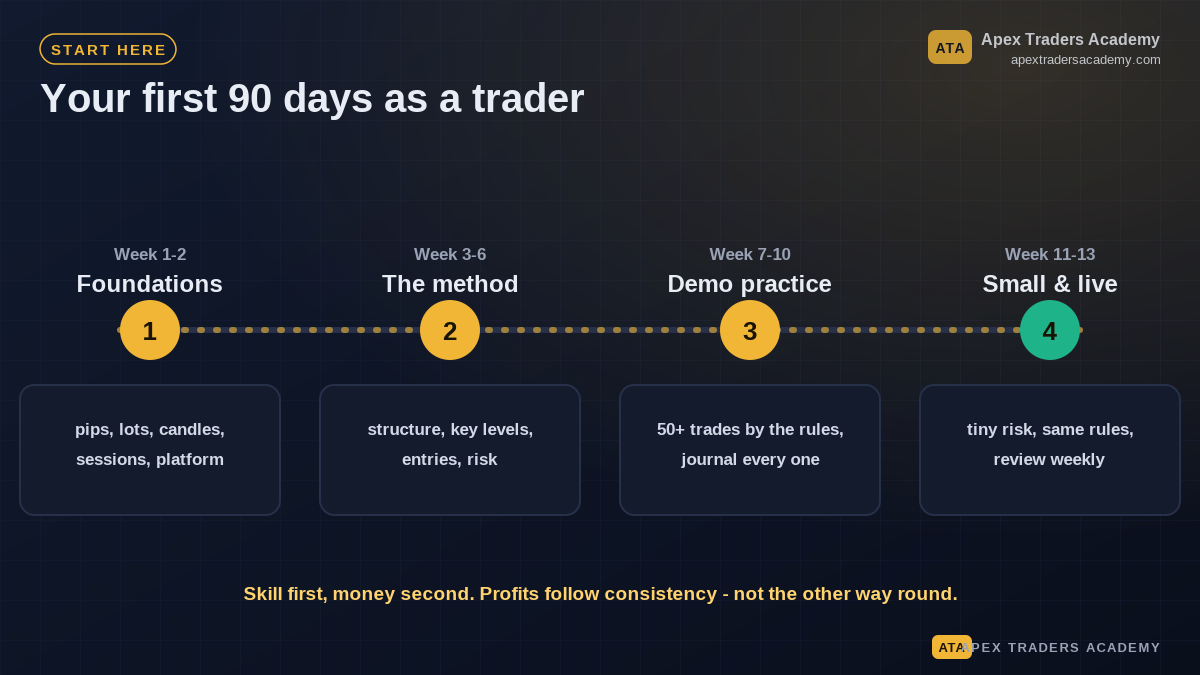
Next lessonYour First 90 Days in Trading: A Roadmap for Complete Beginners →
Most beginners lose money in their first three months - not because trading is impossible, but because they do things in the wrong order. Here is the right order.