How Much Do You Need to Start Forex Trading in Nigeria? (Naira Examples)
How much do you need to start forex trading in Nigeria? Real naira examples of what small, medium and larger accounts can risk per trade, and the smart way to begin.

How much do you need to start forex trading in Nigeria? Technically, very little - many brokers let you open an account with a small deposit, and a demo account costs nothing. But the better question is: how much do you need to trade properly, without gambling? This guide answers both, with naira examples, so you can start with an amount that fits your plan instead of your hopes.
The short answer
- ₦0 - to learn. Practise on a free demo account and free charts first.
- A small amount you can afford to lose completely - for your first live account. Its job is to teach you how you behave with real money, not to replace your salary.
- More capital only after you have a track record - weeks of journaled trades showing you follow your rules.
The amount matters less than the percentage you risk on each trade. That is the number that decides whether you survive long enough to get good.
Why the 1% rule decides how much you need
Professional traders risk a small, fixed percentage of their account per trade - we teach 1%. Our full lesson on the 1% risk rule explains why, but here is the idea in one line: if you risk 1% per trade, even ten losses in a row leave you with about 90% of your account.
That means the size of your account decides the naira value of 1%:
| Account size | 1% risk per trade | What it means |
|---|---|---|
| ₦50,000 | ₦500 | Learning account - focus on following rules |
| ₦200,000 | ₦2,000 | Enough to trade small lots on most pairs |
| ₦500,000 | ₦5,000 | Comfortable for a careful part-time trader |
| ₦2,000,000 | ₦20,000 | Serious account - only after a proven track record |
These are illustrative numbers. The exact lot size depends on your stop loss and the pair - see how to calculate your lot size.
How to start forex trading in Nigeria with a small account
Step 1: Learn and practise for free
Use a demo account and free charting. On Apex Charts you can mark key levels and practise entries with bar replay, without spending a kobo.
Step 2: Start live with "tuition money"
Your first live account is tuition. Choose an amount that would not change your life if you lost it all - many beginners choose something between ₦50,000 and ₦200,000. Never use rent, school fees, borrowed money or business capital.
Step 3: Use micro or small lots
Most brokers offer small lot sizes, so even a small account can risk 1% properly. Understanding pips, lots and leverage is essential before you place your first live trade.
Step 4: Journal every trade
Record your entries, exits, reasons and emotions in a trading journal. After 30-50 trades you will know whether you are ready to add capital.
Step 5: Grow the account with results, not deposits
Add money only when your journal shows you follow your plan consistently. Doubling your deposit does not double your skill.
A worked example in naira
Amaka starts with ₦150,000. She risks 1% - ₦1,500 - per trade.
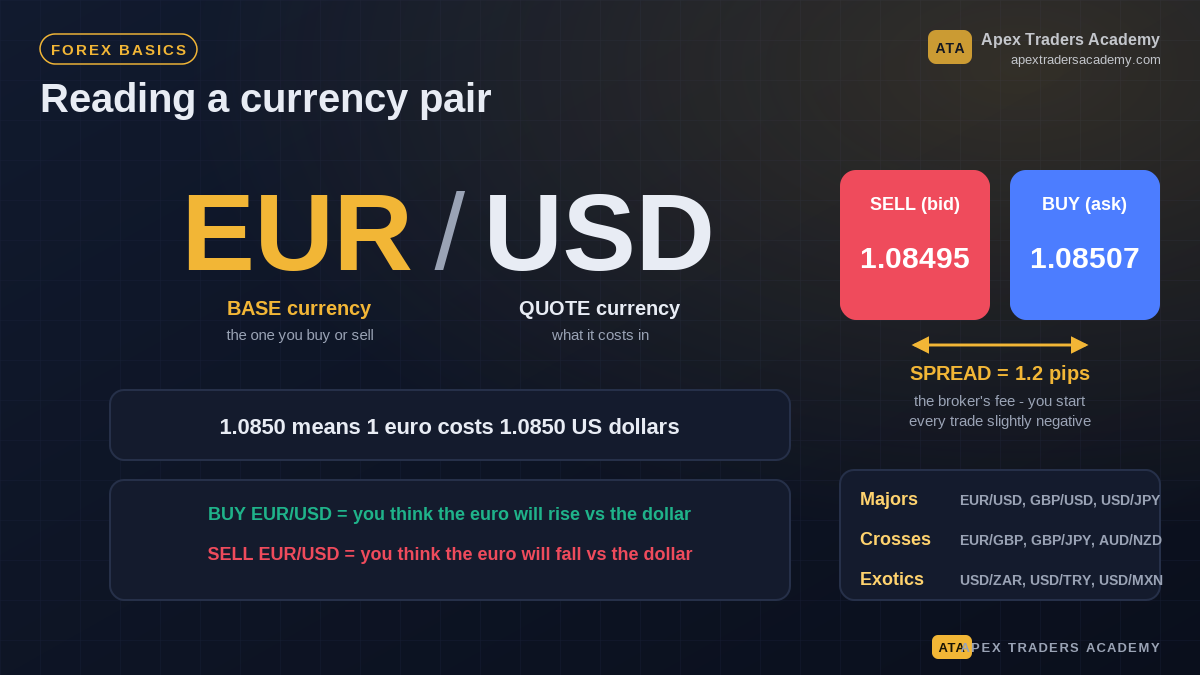
She finds a buy setup on EUR/USD at a daily support level. Her stop loss is 30 pips below her entry and her target is 90 pips above (a 1:3 risk to reward - see why 1:3 beats a high win rate).
- If the trade loses, she loses about ₦1,500 - 1% of her account.
- If it wins, she makes about ₦4,500 - 3%.
Even if she wins only 4 trades out of 10, the maths works: 4 wins × ₦4,500 = ₦18,000, minus 6 losses × ₦1,500 = ₦9,000, leaves about ₦9,000 profit - with a small account and a lower win rate than most beginners expect.
The point is not to get rich from ₦150,000. It is to prove the process. Once the process works, more capital - or a funded prop firm account - can follow.
Leverage: why "you can start with $10" is dangerous
Brokers often advertise high leverage, which lets a tiny deposit control a big position. Leverage does not change how much you should risk - it only changes how much you can lose quickly. A beginner with a small account and high leverage can wipe out the deposit in one bad trade. Keep risk at 1%, and leverage becomes a tool instead of a trap.
Hidden costs to plan for
- Spreads and commissions on each trade.
- Swap/overnight fees if you hold trades for days.
- Funding and withdrawal costs, including exchange-rate differences when converting naira.
- Education - a good course costs money, but losing money while learning by trial and error usually costs more.
Frequently asked questions
How much do I need to start forex trading in Nigeria?
You can learn for free on a demo account. For a first live account, use a small amount you can afford to lose - what matters most is risking about 1% per trade.
Can I start forex with ₦10,000?
It may be possible with some brokers, but it is very hard to risk 1% properly on such a small balance. Treat it as practice, not income.
How much is good to start forex trading?
Enough that 1% risk lets you place trades with sensible stop losses - for many beginners that is roughly ₦100,000 to ₦500,000 - and an amount you can afford to lose while learning.
How much can I make from forex in Nigeria?
There is no fixed amount and no guarantee. Results depend on your method, risk management and discipline. Be wary of anyone promising a monthly income.
Is it better to start with a prop firm?
Prop firm challenges let you trade a larger account for a fee, but you still need a proven method and strict risk control to pass. Build your skills on a demo or small account first.
Start the right way
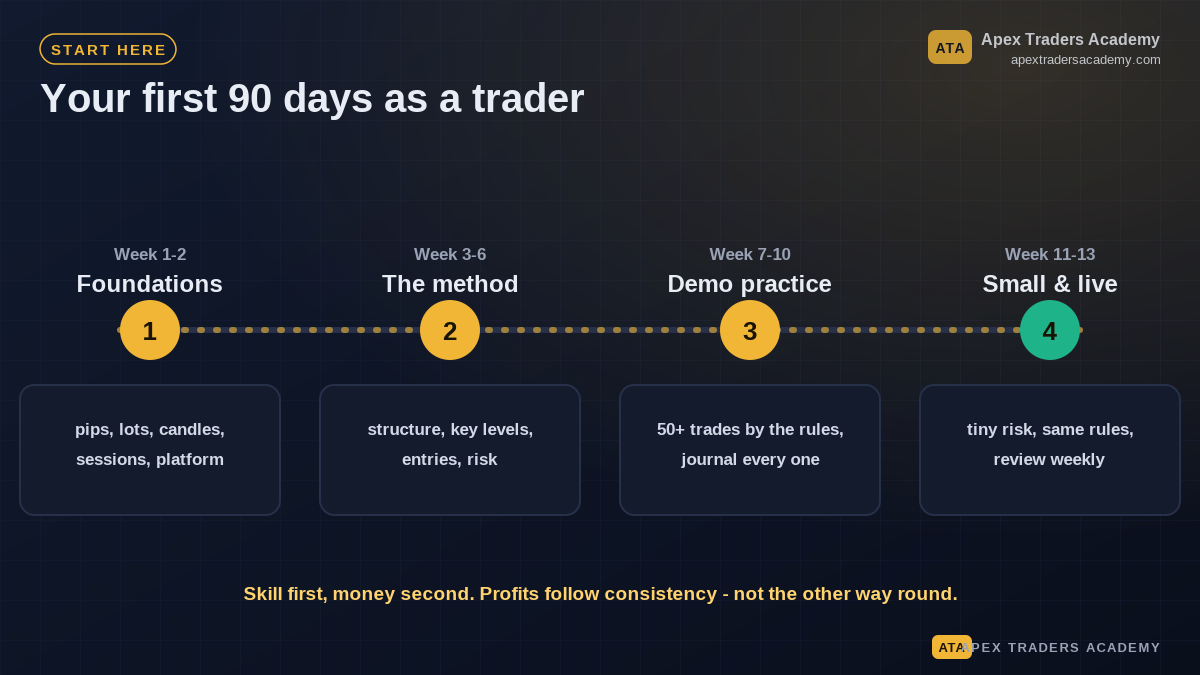
Before you decide how much to deposit, learn the method and the risk rules. Start with our first 90 days roadmap, practise on Apex Charts, track everything in the free journal, and join the Apex Trading course when you want structured mentorship.
Education only - not financial advice. Examples are illustrative. Trading on margin is risky; never risk money you can't afford to lose.
Want to see this on live charts?
Inside the course we apply every lesson to real Weekly, Daily and 4H charts - with mentorship until it clicks.
Education only, not financial advice. Trading on margin carries a high level of risk. Always use a stop loss and risk only what you can afford to lose.
Next lessonIs Forex Trading Profitable in Nigeria? Honest Answers for Beginners →
Is forex trading profitable in Nigeria? It can be - for disciplined traders with a tested method. Why most beginners lose, and what profitable traders do differently.