What Is Forex? How the Currency Market Really Works
The biggest financial market on earth explained in plain English - who trades it, why prices move and how you can take part.
Forex (FX) is short for foreign exchange - the global market where currencies are bought and sold. When a Nigerian importer pays a supplier in China, when a tourist changes dollars to euros, or when a bank in London buys Japanese yen, they are all using the forex market.
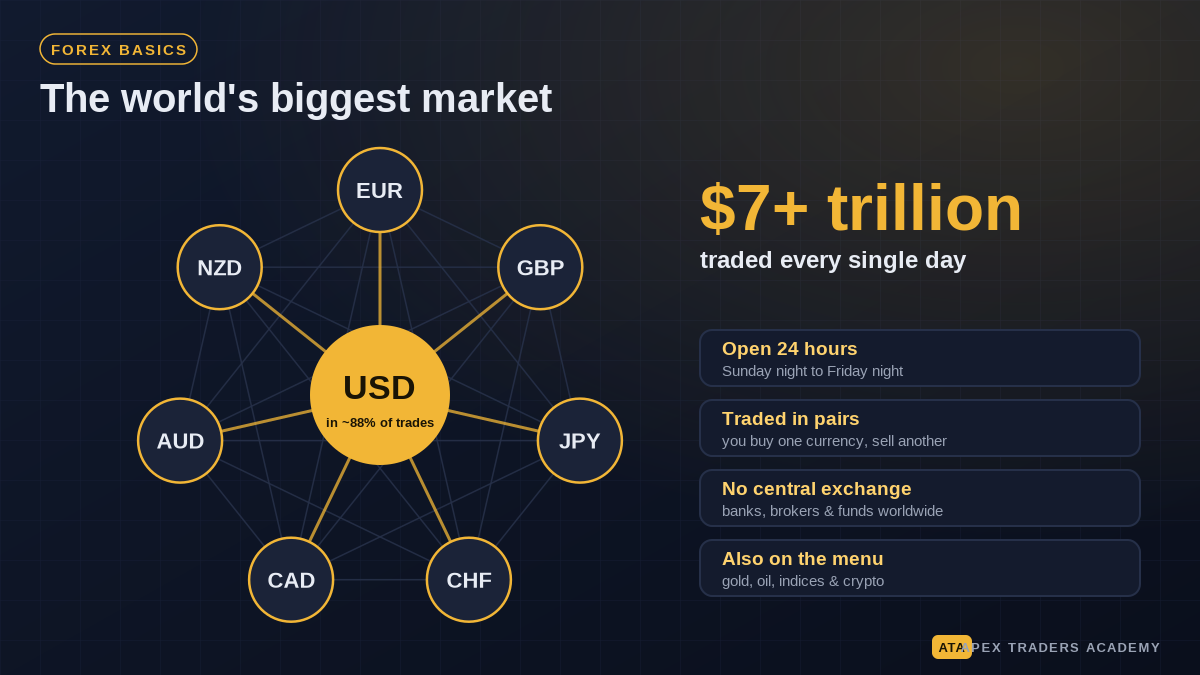
It is the largest financial market in the world: well over $7 trillion changes hands every single day - more than all the world's stock markets combined.
Who trades forex?
- Central banks - like the US Federal Reserve or the Central Bank of Nigeria, managing their currencies
- Commercial banks - the biggest players by far, trading for clients and themselves
- Companies - paying for imports, exports and foreign salaries
- Funds - hedge funds and investment funds looking for profit
- Retail traders - people like you and me, trading through a broker
Retail traders are a small part of the market. That matters: we can't move prices, so we have to follow what the big money does. Much of what we teach - key levels, liquidity, market structure - is really about reading the footprints of the big players.
Why do currency prices move?
A currency's value is like the price of anything else: supply and demand. Demand for a currency rises when:
- Its country raises interest rates (investors earn more holding it)
- Its economy is strong (jobs, growth, controlled inflation)
- Investors see it as safe in times of fear (the US dollar, Japanese yen and Swiss franc)
That's why traders watch the economic calendar - news about jobs, inflation and interest rates can move a currency in seconds.
How do you trade it?
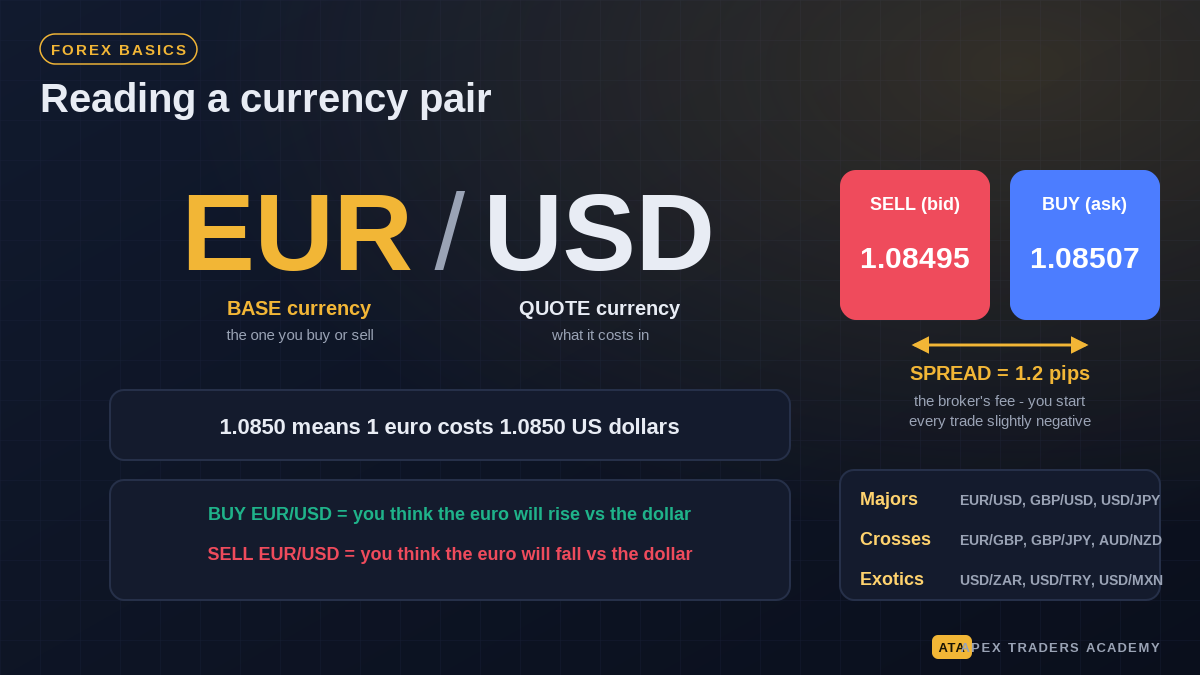
You always trade one currency against another, as a pair. If you think the euro will strengthen against the US dollar, you buy EUR/USD. If you think it will weaken, you sell EUR/USD. Yes - you can profit when prices fall, not only when they rise.
Retail traders use a broker and a platform like MetaTrader or TradingView. You don't receive physical euros; you trade a contract (usually a CFD) that follows the price.
The market hours
Forex runs 24 hours a day, five days a week - from Sunday night to Friday night (Nigeria time). It follows the sun from Sydney to Tokyo, London and New York. More on that in the trading sessions lesson.
Beyond currencies
Most forex brokers also let you trade:
- Gold (XAU/USD) and silver (XAG/USD)
- Oil (WTI and Brent)
- Indices like US30 (Dow Jones), NAS100 and GER40
- Crypto like BTC/USD
The same skills - structure, key levels, risk management - work on all of them.
Next lesson: How to read a currency pair: base, quote, bid, ask and spread
Want to see this on live charts?
Inside the course we apply every lesson to real Weekly, Daily and 4H charts - with mentorship until it clicks.
Education only, not financial advice. Trading on margin carries a high level of risk. Always use a stop loss and risk only what you can afford to lose.
Next lessonHow to Read a Currency Pair: Base, Quote, Bid, Ask & Spread →
EUR/USD at 1.0850 - what does it actually mean? Learn to read any quote in two minutes and understand the hidden cost of every trade.