How to Choose a Broker - and Spot Trading Scams Before They Spot You
Account managers, "double your money" schemes and fake profit screenshots cost traders millions. Here's how to protect yourself.
Before you learn a single strategy, learn this: the fastest way to lose money in trading is not a bad trade. It's a scam. Every week, traders lose savings to "account managers", fake investment platforms and "send USDT and we'll double it" schemes.
What a good broker looks like
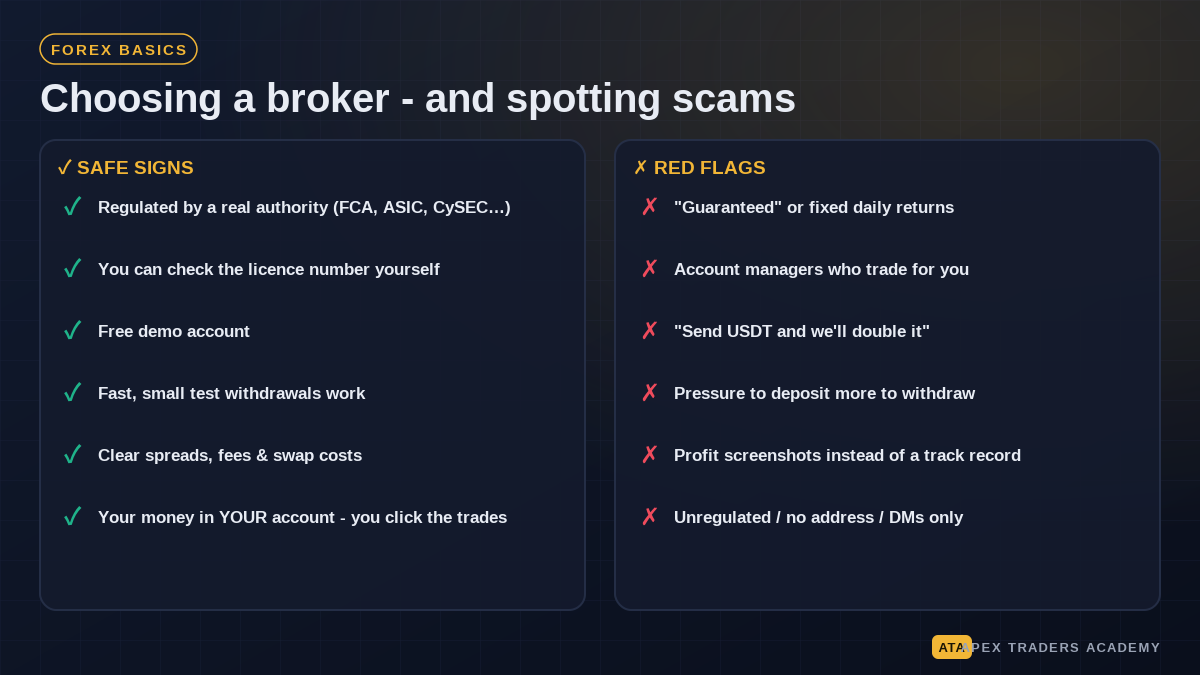
- Regulated by a real financial authority - for example the FCA (UK), ASIC (Australia), CySEC (Cyprus) or the FSCA (South Africa). Many brokers also hold offshore licences, which offer less protection.
- Verify the licence yourself on the regulator's own website - never trust a screenshot
- A free demo account
- Clear information on spreads, commissions and swap fees
- Withdrawals that work - test with a small amount first
- You control your account and you click every trade
Red flags: walk away immediately
- "Guaranteed" or fixed returns - "5% daily", "double in 7 days". No real trader can promise this.
- Account managers who want your login to "trade for you"
- "Send me USDT and I'll invest it" - once crypto is sent, it's gone
- Pressure to deposit more before you can withdraw ("pay the tax first")
- Profit screenshots instead of a verified track record
- No physical address, no regulator, DMs only
- Someone who contacted you first on WhatsApp, Telegram or Instagram
If someone could really make 30% a month, they wouldn't need your $500.
Signal sellers and "VIP groups"
Not every signal group is a scam, but be careful. Common tricks: deleting losing signals, showing only winning screenshots, and sending the same "signal" in both directions to different groups. If they can't show a long, verified history with losses included, treat it as marketing.
A simple safety checklist
- Is the broker regulated, and did I check the licence on the regulator's site?
- Did I test a small withdrawal?
- Am I the only one with my login details?
- Does anyone promise me a fixed profit? (If yes - leave.)
- Am I depositing money I can afford to lose?
At Apex Traders Academy we will never ask for your trading login, never manage your money and never promise profits. We teach - you trade.
Next lesson: How to read a candlestick chart
Want to see this on live charts?
Inside the course we apply every lesson to real Weekly, Daily and 4H charts - with mentorship until it clicks.
Education only, not financial advice. Trading on margin carries a high level of risk. Always use a stop loss and risk only what you can afford to lose.
Next lessonHow to Read a Candlestick Chart (The Language of Price) →
Each candle tells a short story of a battle between buyers and sellers. Learn to read it and the chart starts talking to you.