How to Read a Currency Pair: Base, Quote, Bid, Ask & Spread
EUR/USD at 1.0850 - what does it actually mean? Learn to read any quote in two minutes and understand the hidden cost of every trade.
Every forex price looks like this: EUR/USD 1.0850. Once you understand those few characters, you can read any market on your screen.
Base and quote
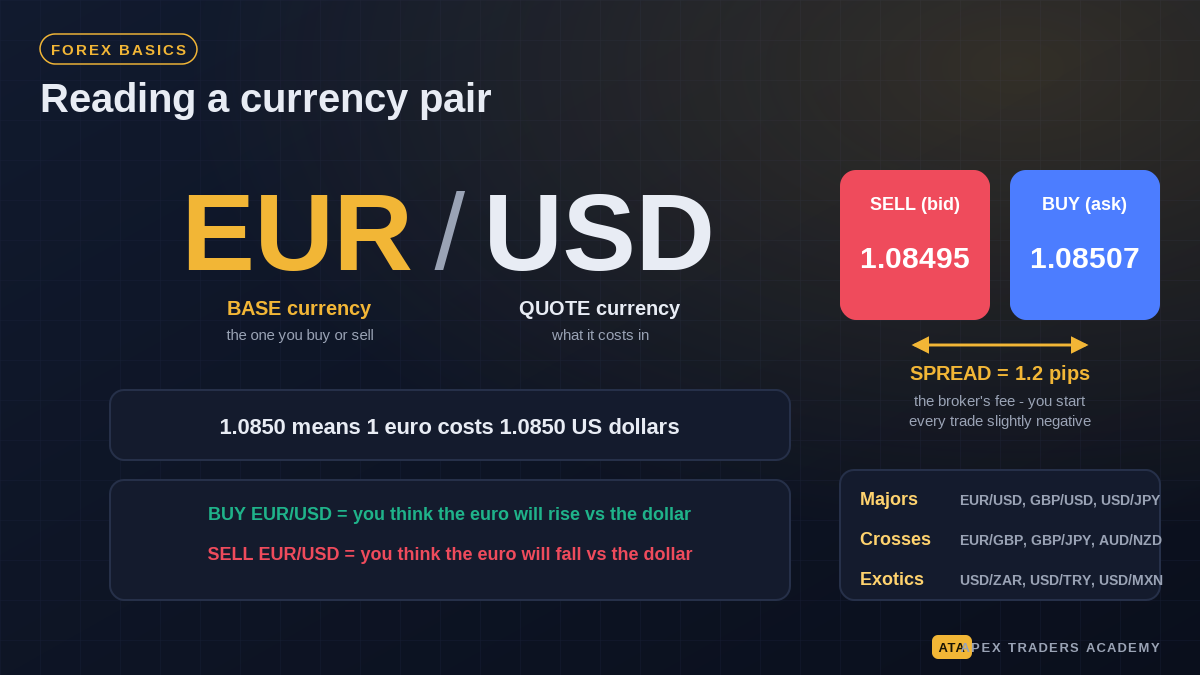
- The first currency is the base currency (EUR)
- The second currency is the quote currency (USD)
- The price tells you how much of the quote currency one unit of the base costs
So EUR/USD = 1.0850 means 1 euro costs 1.0850 US dollars.
What buying and selling really means
- Buy EUR/USD → you think the euro will rise against the dollar
- Sell EUR/USD → you think the euro will fall against the dollar
You are always buying one currency and selling the other at the same time. Buying GBP/JPY means buying pounds and selling yen.
Bid, ask and spread
Your broker always shows two prices:
- Bid - the price you sell at (the lower one)
- Ask - the price you buy at (the higher one)
The gap between them is the spread. It's the broker's fee, built into the price. If EUR/USD bid is 1.08495 and ask is 1.08507, the spread is 1.2 pips.
When spreads widen
Spreads are usually tightest during the London and New York sessions. They widen:
- Around big news like NFP or interest rate decisions
- At the daily rollover (around 23:00 Nigeria time)
- On Sunday night when the market opens
- On exotic pairs all the time
Majors, crosses and exotics
| Type | Examples | Spread |
|---|---|---|
| Majors (with USD) | EUR/USD, GBP/USD, USD/JPY, AUD/USD | Lowest |
| Crosses (no USD) | EUR/GBP, GBP/JPY, AUD/NZD | Low - medium |
| Exotics | USD/ZAR, USD/TRY, USD/MXN | High |
Beginners should start with majors and gold: tight spreads, smooth charts, plenty of education available.
Quick check
If GBP/USD moves from 1.2700 to 1.2750, did the pound get stronger or weaker? Stronger - one pound now buys more dollars. If you bought, you're in profit.
Next lesson: Pips, lots and leverage explained simply
Want to see this on live charts?
Inside the course we apply every lesson to real Weekly, Daily and 4H charts - with mentorship until it clicks.
Education only, not financial advice. Trading on margin carries a high level of risk. Always use a stop loss and risk only what you can afford to lose.
Next lessonPips, Lots and Leverage Explained Simply →
The three words that decide how much you make or lose on every trade. Master them before you ever press buy.