How to Build a Trading Plan (Free One-Page Template)
A trading plan turns trading from guessing into a business. Here's what goes in it - and a template you can copy tonight.
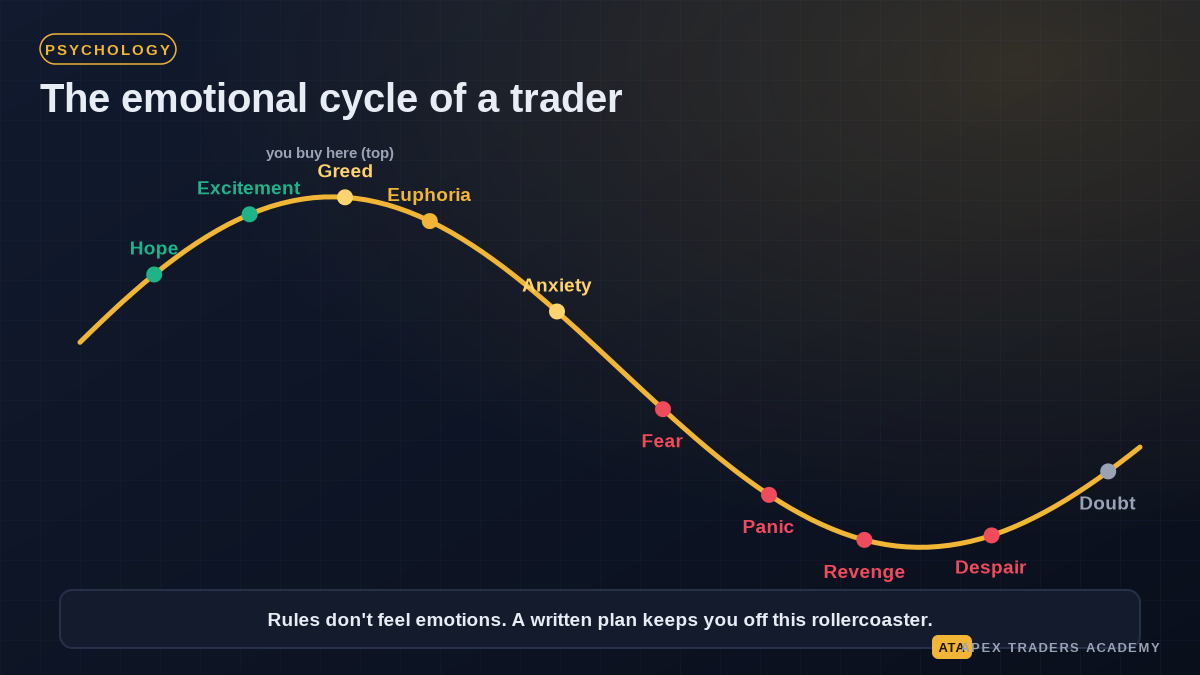
Pilots use checklists. Surgeons use checklists. Yet most traders click buy and sell based on how they feel that day. A trading plan is your written rulebook - decided calmly before the market moves, followed exactly when it moves.
Why you need one
- It removes emotional decisions in the moment
- It makes your results measurable - you can't improve what changes every day
- It protects you from strategy-hopping
- It's the difference between a gambler and a business owner
The 7 sections of a trading plan
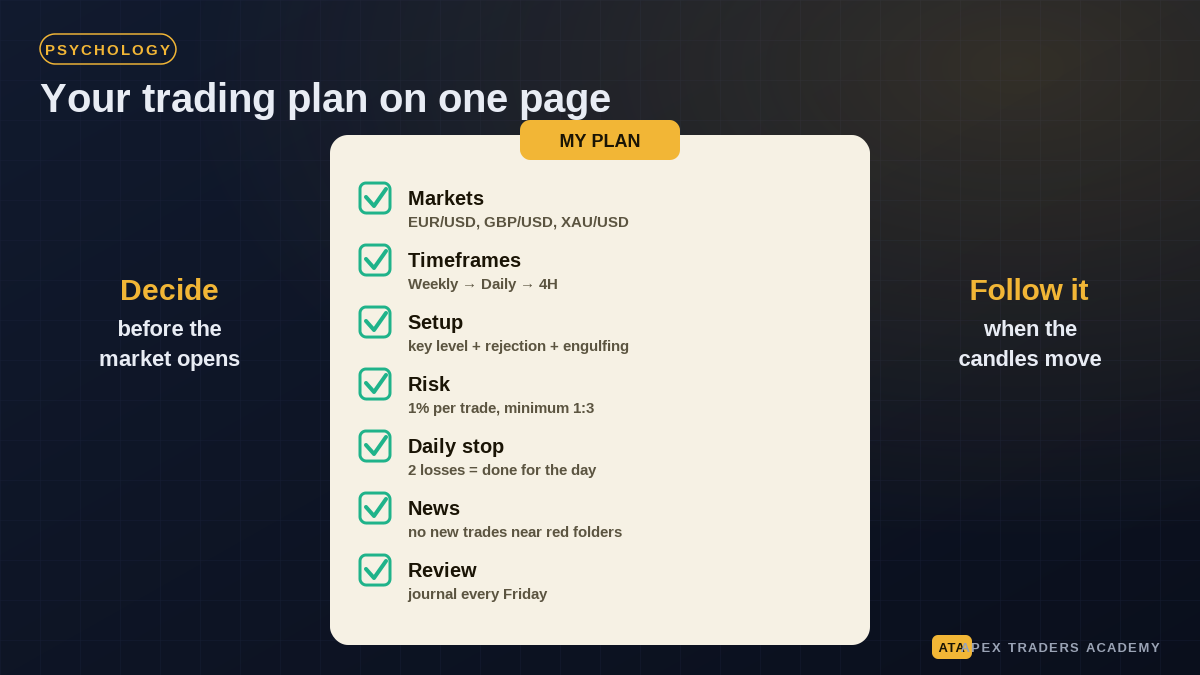
1. Markets
Which markets will you trade? Start with 3 to 5. Example: EUR/USD, GBP/USD, XAU/USD, US30.
2. Timeframes
Which timeframe does what? Example: Weekly for bias, Daily for zones, 4H for entries.
3. Setup rules
Exactly what must happen before you enter. Write it as a checklist, for example:
- Weekly rejection of a key level gives the bias
- Price at a daily zone, at a discount (buys) or premium (sells)
- 4H engulfed + engulfing pair (or CHoCH after a sweep) in the bias direction
- Minimum 1:3 risk:reward to the next level
4. Risk rules
- Risk per trade: 1% (0.5% while learning live)
- Stop loss: beyond the zone / sweep wick
- Maximum open trades at once: e.g. 3
- No moving the stop further away. Ever.
5. Daily and weekly limits
- 2 losses in a day → stop for the day
- -4% in a week → stop and review
6. News rules
No new trades 30 minutes before and after high-impact news on that currency. Check the calendar each morning.
7. Review routine
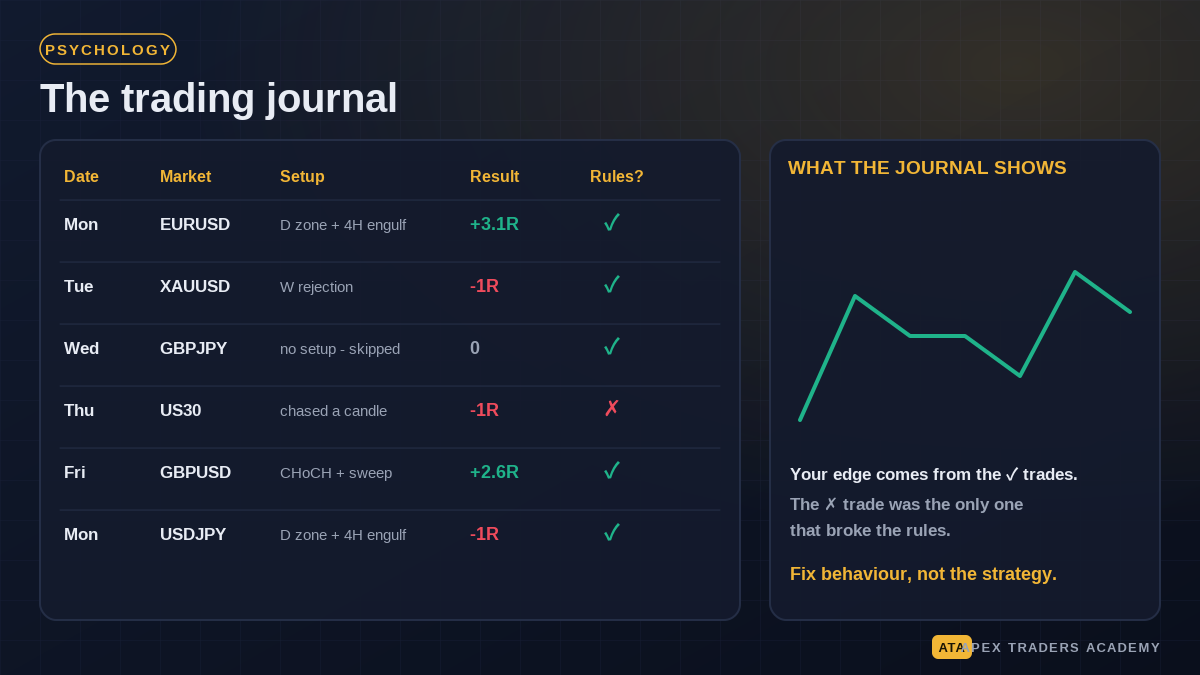
Every Friday: review the journal. Which rules did I follow? Which did I break? What's one thing to improve next week?
Copy this template
| Section | My rule |
|---|---|
| Markets | |
| Timeframes | |
| Entry checklist | |
| Risk per trade | 1% |
| Stop loss placement | |
| Minimum R:R | 1:3 |
| Daily stop | 2 losses |
| News rule | No trades around red folders |
| Review day | Friday |
Write yours, print it, and stick it next to your screen.
Next lesson: The trading journal: the habit that separates pros from gamblers
Want to see this on live charts?
Inside the course we apply every lesson to real Weekly, Daily and 4H charts - with mentorship until it clicks.
Education only, not financial advice. Trading on margin carries a high level of risk. Always use a stop loss and risk only what you can afford to lose.
Next lessonThe Trading Journal: The Habit That Separates Pros From Gamblers →
The fastest way to improve as a trader costs nothing and takes five minutes a trade. Here's exactly what to record - and what to look for.