Position Sizing: How to Calculate Your Lot Size (With Examples)
The one calculation every trader must do before every trade - with worked examples for EUR/USD, gold, GBP/JPY and US30.
You know you should risk 1% per trade. But how do you turn "1%" into the number you type in the lot size box? That's position sizing - and it's the most important calculation in trading.
The formula
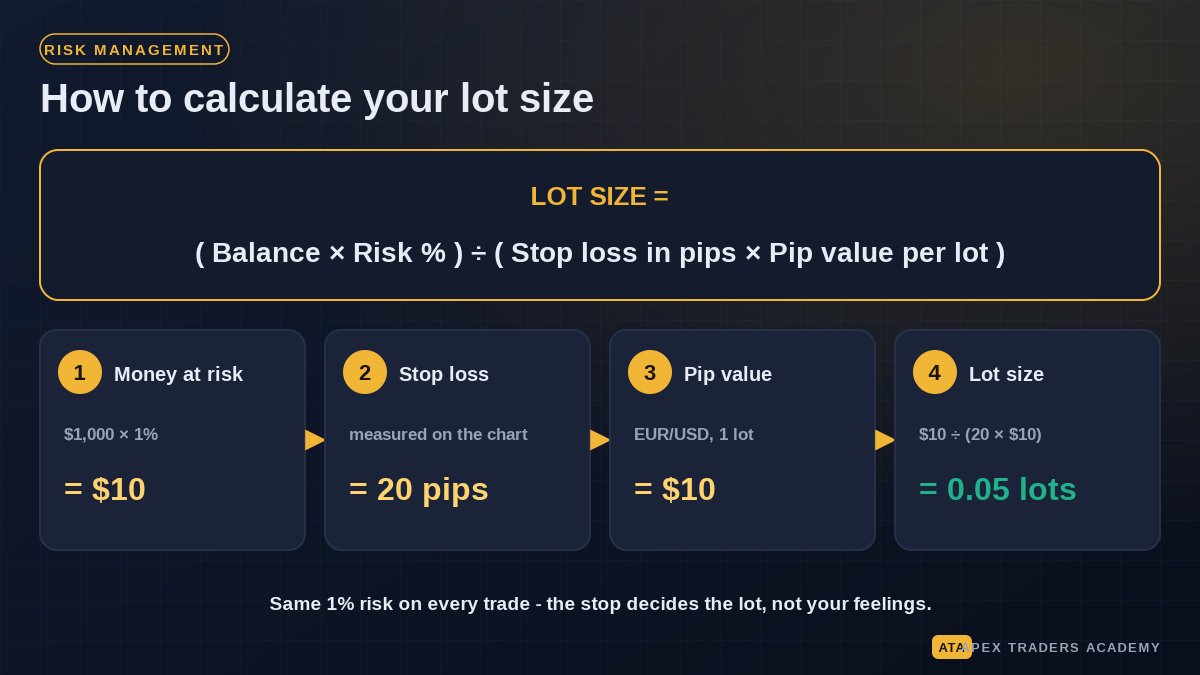
Lot size = (Account balance × Risk %) ÷ (Stop loss in pips × Pip value per lot)
Three things decide it:
- How much money you're willing to lose (balance × 1%)
- How far your stop loss is (in pips, from your chart - not a random number)
- How much one pip is worth on that market (pip value per standard lot)
Example 1: EUR/USD
- Balance: $1,000 → 1% risk = $10
- Stop loss: 20 pips
- Pip value: about $10 per lot
- Lot size = $10 ÷ (20 × $10) = 0.05 lots
Example 2: Gold (XAU/USD)
- Balance: $1,000 → 1% = $10
- Stop loss: $5 move = 50 pips (1 pip = $0.10)
- Pip value: $10 per lot (100 oz contract)
- Lot size = $10 ÷ (50 × $10) = 0.02 lots
Example 3: GBP/JPY
JPY pairs are quoted in yen, so a pip is worth 1,000 yen per lot, converted to dollars. With USD/JPY around 155, that's about $6.45 per pip.
- Balance: $2,000 → 1% = $20
- Stop loss: 40 pips
- Lot size = $20 ÷ (40 × $6.45) = 0.07 lots (rounded down)
Example 4: US30
Index contract sizes vary by broker. Many brokers use $1 per point per lot, some use $10 or more - check your broker's contract specification.
- Balance: $1,000 → 1% = $10
- Stop loss: 100 points, contract $1 per point
- Lot size = $10 ÷ (100 × $1) = 0.10 lots
Use the calculator
Pip values change with exchange rates, and crosses like EUR/GBP or AUD/NZD are fiddly to work out by hand. Our pip & position size calculator uses live exchange rates and covers every major, cross and exotic pair, plus metals, oil, indices and crypto. Pick the market, type your balance, risk and stop - it gives you the lot size.
Always round down
If the answer is 0.057 lots, use 0.05, not 0.06. Rounding up means risking more than you planned.
Next lesson: Risk:reward - why 1:3 beats a high win rate
Want to see this on live charts?
Inside the course we apply every lesson to real Weekly, Daily and 4H charts - with mentorship until it clicks.
Education only, not financial advice. Trading on margin carries a high level of risk. Always use a stop loss and risk only what you can afford to lose.
Next lessonRisk : Reward - Why 1:3 Beats a High Win Rate →
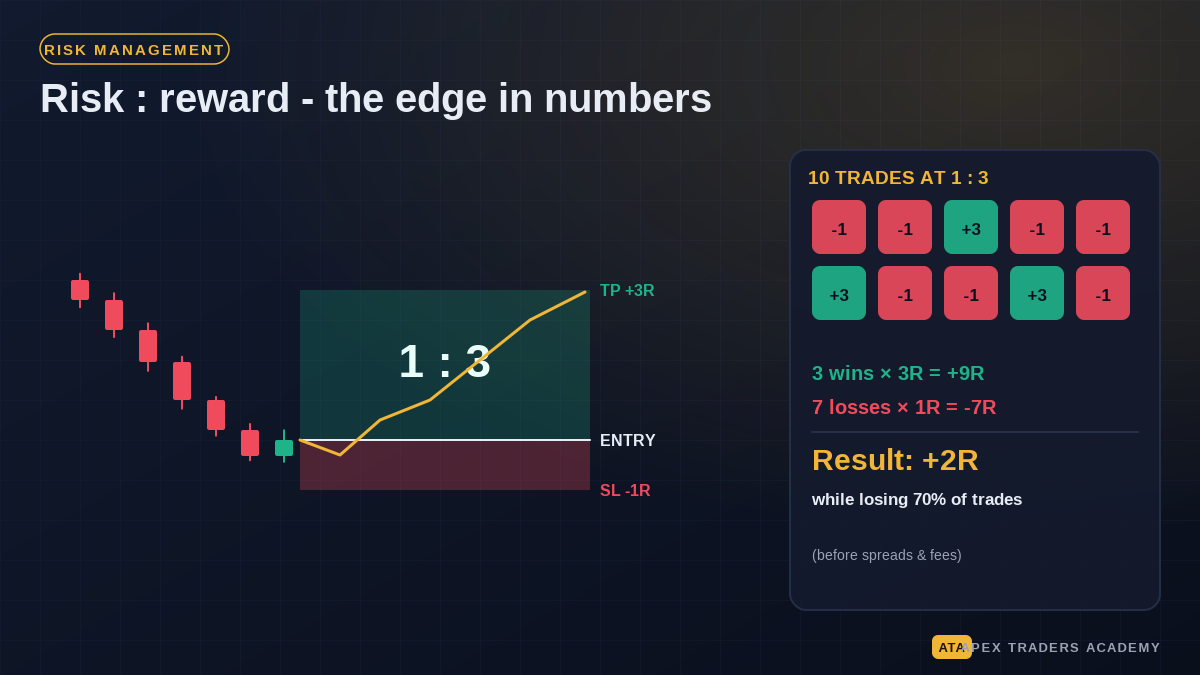
You can lose 7 out of 10 trades and still make money. Here's the maths that changes how you think about trading.