Best Forex Trading Strategy for Beginners: Rules That Fit You
The best forex trading strategy is not one universal setup; choose defined rules, controlled risk and a journal, then practise a simple top-down method consistently.

There is no single best or most profitable forex trading strategy for everyone. A useful strategy has rules you can explain, a clear invalidation point, controlled position size and a review process. For beginners, a top-down key-level method can provide a simple structure for making and recording decisions.
No strategy guarantees profits. Results vary with market conditions, costs, execution and whether the trader follows the rules. A strategy that looks simple in hindsight can be difficult to apply in real time, so practise before risking money.
What makes a strategy useful?
A strategy should answer the same questions every time: what market will you study, what context matters, what triggers a setup, where is the idea wrong, how much can you lose, and how will you exit? If those answers change from trade to trade without a rule, you are reacting rather than following a method.
The “best” method is one you understand and can apply consistently within your available time and risk tolerance. Scalping, swing trading and longer-term approaches differ in pace and exposure. A fast method is not automatically better, and a high win rate alone does not establish that a strategy is sound.
Costs matter. A method that targets very small moves can be sensitive to spread and execution. A method that holds longer may face overnight costs or event exposure. Learn the product and platform conditions before comparing strategies.
A beginner-friendly top-down key-level strategy
This is a framework for study, not a promise of results. It uses Weekly -> Daily -> 4H analysis, A/V key levels, candle closes and a defined risk plan. Its purpose is to make the decision process clear enough to practise and review.
1. Set your market and schedule
Choose one or a small number of instruments to study and a consistent review time. Check for scheduled economic events that could affect them. Decide whether your plan allows holding through news or requires you to stand aside. Do not trade simply because you have opened the chart.
2. Read Weekly structure
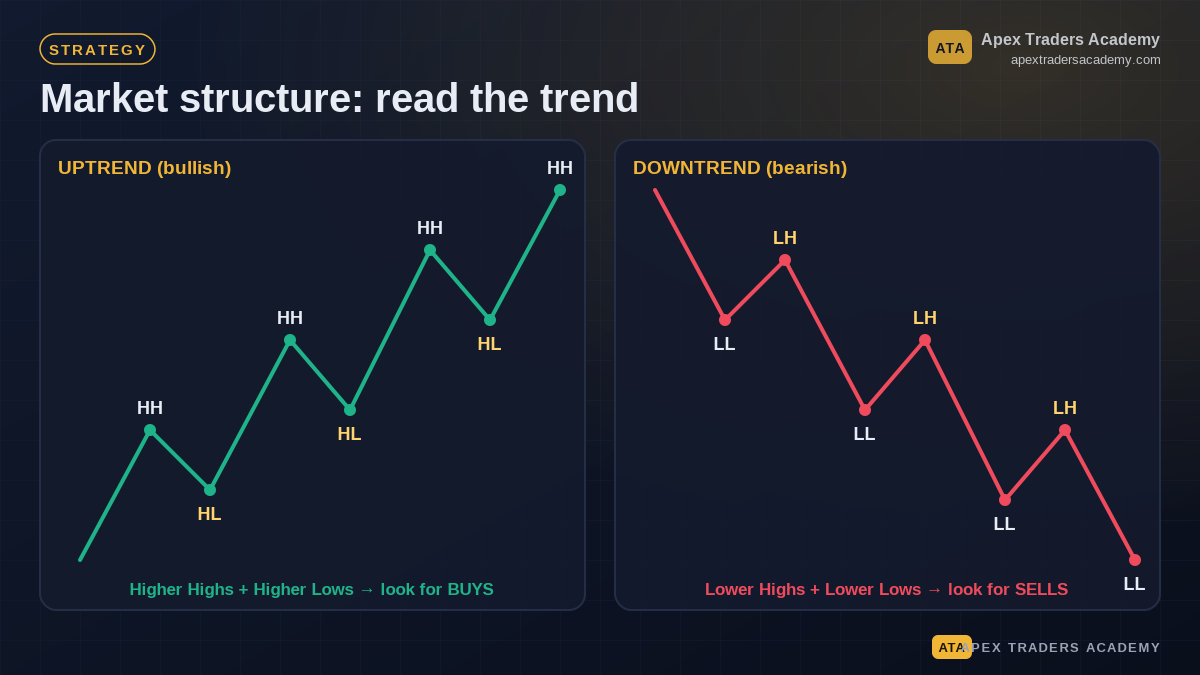
Describe whether the broader market is making higher swing highs and lows, lower swing highs and lows, or moving in a range. Avoid predicting a trend from one candle. Mark the major swing areas that are relevant to current price. For structure vocabulary, read market structure: higher highs and higher lows.
3. Mark Daily A/V key levels
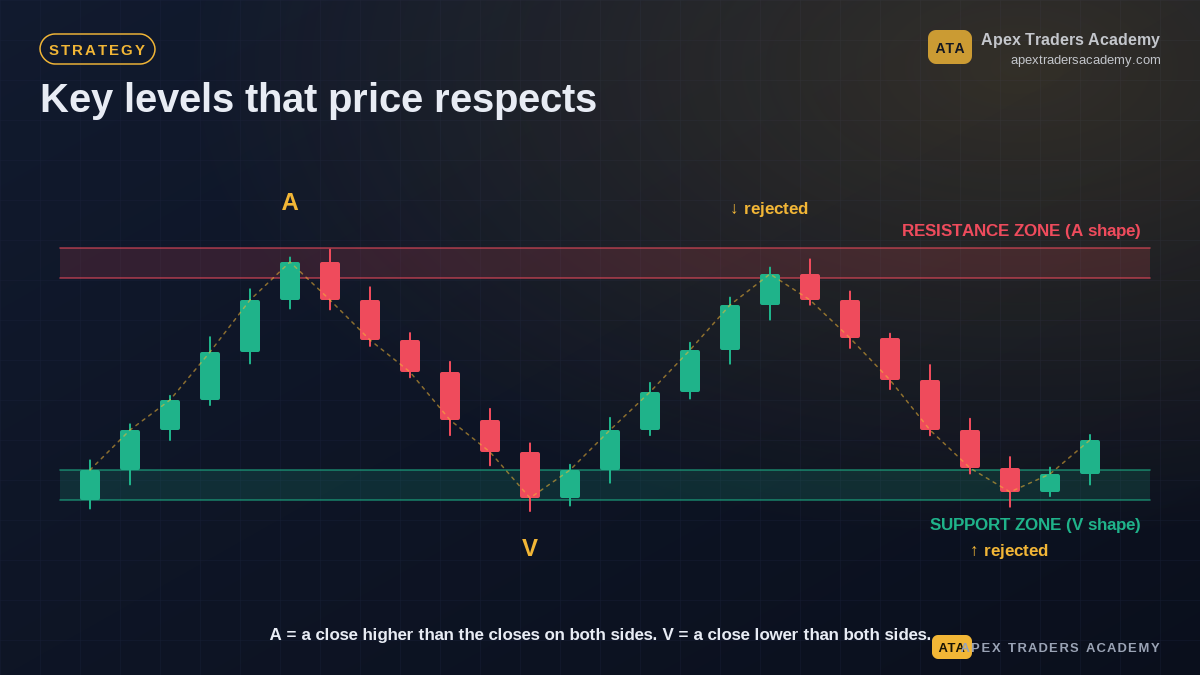
On the Daily chart, identify a small number of areas where price has previously turned, paused or moved decisively. Treat them as zones. Do not draw a line at every minor fluctuation. A level is a location to observe, not an automatic entry signal. See support and resistance key levels.
4. Wait for 4H behaviour
When price reaches a planned area, wait for a reaction that your rules define. It might be a rejection, a close back inside after a sweep, or an engulfed + engulfing candle sequence. Use candle closes consistently. A wick beyond the level is not the same as a close beyond it.
For example, suppose Weekly structure is rising and Daily price has returned to an illustrative support zone. On 4H, price dips below a prior low and closes back above the zone, then the next candle closes above the previous candle’s body. This may qualify for further assessment under a written rule; it does not compel a trade or guarantee a rise.
5. Define invalidation and position size
Before entering, decide what price action would show the idea is wrong. Place the stop according to that invalidation, then calculate the position size from the amount you are willing to lose. Do not pick a size first and squeeze the stop to make it fit.
For an illustrative calculation, suppose the account balance is ₦300,000 and the trader’s chosen risk cap is 1%, or ₦3,000. If the stop is wide, the position must be correspondingly smaller. Cash risk also depends on pip value, account currency, product contract and costs. Read the one percent risk rule, how to calculate lot size, and risk-reward ratio explained.
6. Plan the exit and record the trade
Choose a target or exit rule that makes sense for the setup. Do not extend a target only to create an attractive risk-reward ratio on paper. Record the plan before entry, then note whether you followed it. Afterward, review the quality of the decision separately from whether it made money.
Strategy checklist
Use this checklist before every potential trade:
- Have I identified the instrument and checked relevant event risk?
- What is the Weekly context and the Daily area?
- Has price reached a level I marked in advance?
- Did the 4H candle close in the way my rule requires?
- What specific price action invalidates the setup?
- Does the position size fit my chosen cash risk and contract details?
- Have I planned the exit and checked my existing exposure?
- Am I calm, and will I accept the planned loss without changing the rules?
If an answer is no, wait or skip. A checklist should help you make fewer impulsive decisions, not manufacture a trade when conditions are absent.
Test a method before judging it
Use historical charts and demo practice to collect examples. Write the setup definition before reviewing what happened next. Include trades that would have lost, missed opportunities, ambiguous examples and cases where you correctly stood aside. Avoid changing rules after each result.
A journal can help you track whether a setup actually met your criteria, how much risk was planned, and whether execution followed the plan. Review a batch of decisions rather than drawing conclusions from one or two trades. How to build a trading plan and trading journal habit provide ways to document and review.
Practise the sequence on Apex Charts. Mark Weekly and Daily levels first, then inspect 4H candles. Save a screenshot before looking ahead. This helps expose hindsight bias and makes your practice more honest.
Common strategy traps
Beware of claims that a strategy wins almost every time or removes risk. Be cautious of methods that require many indicators but cannot explain their rules simply. Do not keep adding filters after every loss until the method only fits old examples. That is overfitting, and it may fail on new price action.
Avoid switching strategies because another trader posted a winning screenshot. A method should be judged on clearly recorded examples, realistic costs, risk limits and your ability to follow it. Your emotional response matters: a technically valid method that leads you to oversize or revenge trade is not suitable in practice.
Frequently asked questions
Which forex trading strategy is the best?
There is no universal best strategy. The most useful one for you is defined, understandable, compatible with your schedule, risk controlled and reviewed honestly over many examples.
What is the most profitable forex strategy?
Profitability cannot be guaranteed by a label or setup. Outcomes depend on rules, market conditions, costs, execution and discipline. Be sceptical of promises of easy or certain returns.
Is the top-down key-level method suitable for beginners?
It can be a structured way to practise because it separates Weekly context, Daily locations and 4H behaviour. It still requires careful risk management and does not guarantee a successful trade.
How many indicators should a beginner use?
There is no required number. Start with tools you can explain and that answer a specific question. Price structure, levels and risk rules can be studied without loading a chart with indicators.
How do I know if my strategy works?
Write fixed rules, record a meaningful set of examples including losses, account for costs, and review whether you followed the plan. A few winning trades do not establish reliable performance.
Education only - not financial advice. Trading on margin is risky; never risk money you can't afford to lose.
Want to see this on live charts?
Inside the course we apply every lesson to real Weekly, Daily and 4H charts - with mentorship until it clicks.
Education only, not financial advice. Trading on margin carries a high level of risk. Always use a stop loss and risk only what you can afford to lose.
Next lessonWhat Is Smart Money Concept in Forex? A Clear Beginner's Guide →
What is smart money concept in forex? It is a price-action framework using terms such as order blocks, liquidity and structure shifts, which need clear rules and risk controls.